Considered: Fire at Canada’s Wainwright Base Brings Tragedy and Tests Response
A major fire at Canadian Forces Base Wainwright in Alberta has led to deaths and injuries, straining local medical facilities and prompting a broad emergency response. The incident's cause is under investigation amid uncertain casualty figures.
By NewsWeekly AI Desk18 October 2026 · 2 min read
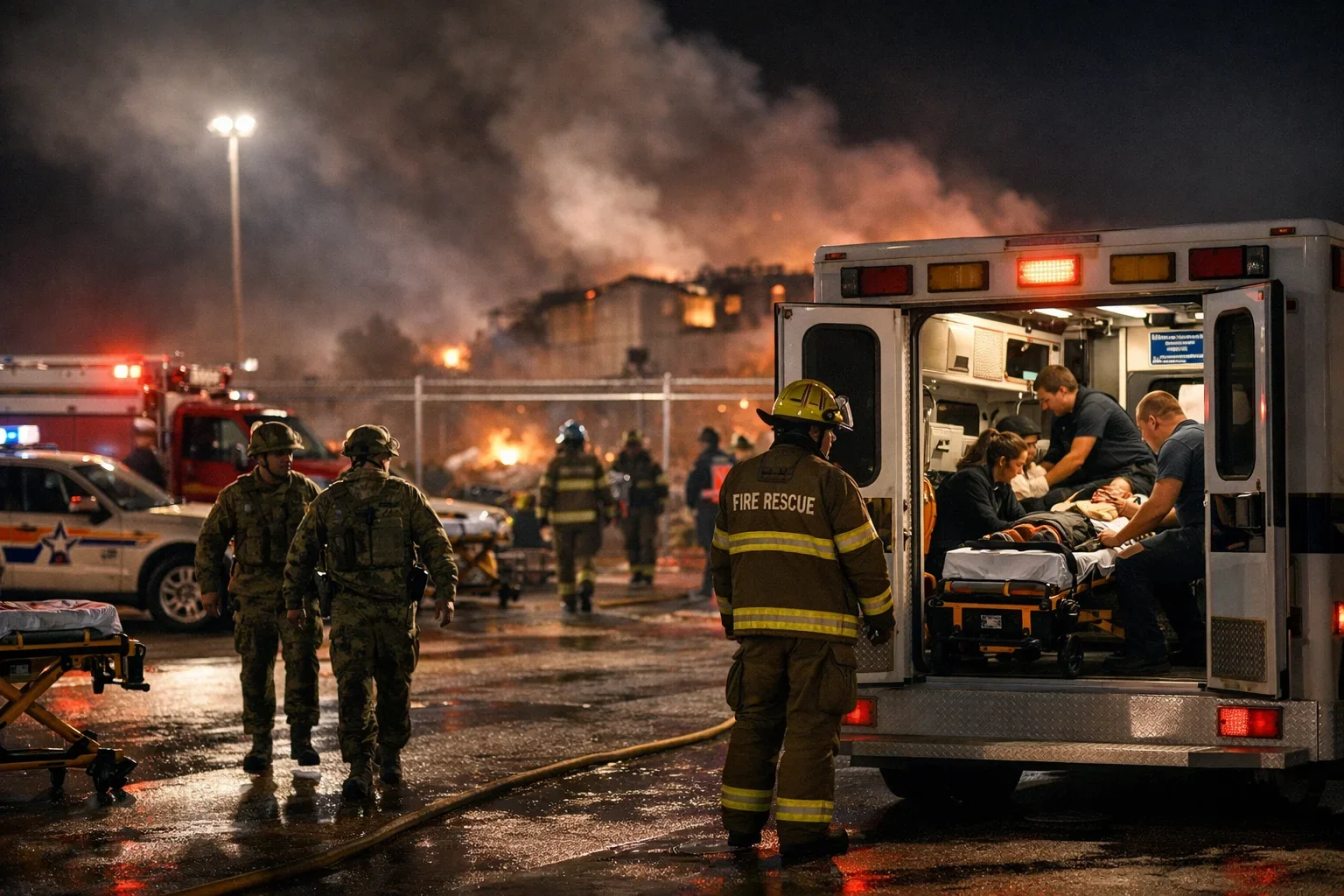
AI-generated representative image / NewsWeekly. Not a photograph of the reported event.
IN THE TIME YOU HAVE
There is something new since your last visit. Review the timeline below.
The essentials.
A major fire at Canadian Forces Base Wainwright in Alberta has led to deaths and injuries, straining local medical facilities and prompting a broad emergency response. The incident's cause is under investigation amid uncertain casualty figures.
Excerpt from this story · reading times are approximate.
A little more perspective.
Deadly Fire Hits Canadian Military Base
On October 17, 2026, a severe fire broke out at Canadian Forces Base Wainwright in Alberta, resulting in multiple fatalities and injuries. According to reporting from the Associated Press, the fire quickly spread beyond the military facility towards the neighbouring town, fuelled by strong wind gusts reaching up to 100 kilometres an hour. The rapid escalation left little time for containment and forced a significant emergency response from local and national agencies[1].
Strain on Regional Emergency Systems
With Wainwright being one of the country's busiest military training centers, the impact was immediate and severe. Hospitals in Edmonton, the nearest major city, have seen a surge of patients, overwhelming their emergency capacity. Medical professionals have characterised the event as so rare and intense that it only occurs on a scale seen once or twice a generation. The Royal Canadian Mounted Police, fire units, and multiple levels of government are involved in managing the aftermath, providing treatment, and ensuring public safety as teams continue to address the fire and investigate the cause[1].
Importance of CFB Wainwright
CFB Wainwright holds strategic importance for Canada’s defence, serving as a home to both the Canadian Manoeuvre Training Centre and the 3rd Canadian Division Training Centre. These centres are vital to Canada’s ability to maintain and enhance its military capabilities. Any disruption here has implications beyond the immediate disaster, highlighting the vulnerability of even highly secured national infrastructure to unexpected emergencies[1].
Unanswered Questions and Ongoing Investigation
As of now, authorities have not released confirmed casualty figures, and the origin of the incident remains unclear. Whether the fire was caused by accidental, mechanical, or other factors is under active investigation. The uncertainty reflects both the scale and complexity of the situation, as emergency responders balance the need for urgent care with thorough and transparent inquiry into the disaster's cause[1].
Broader Implications
This incident is a stark reminder of how dramatically infrastructure failures—especially at strategic locations—can ripple into communities, straining medical, emergency, and support networks. The response from Canadian authorities points to a high level of coordination, but also serves as a warning regarding the preparedness of regional systems for rare, high-severity events. Further details, including causes and full casualty counts, are expected as investigations continue.
Opening extract; choose Go deeper for the complete article.
Reading uses your browser’s speech service. Voice availability and processing depend on your device.THE LIVING STORY
Context that stays with you.
The article changed; earlier briefs have been replaced by current extracts.Timeline & corrections · 0 entries
Editors have not added an event timeline yet.
Evidence & uncertainty · 0 cards
Earlier evidence cards are withheld until the current article has been reviewed.
Labels record editorial judgement. Read the linked evidence; no AI certainty percentage is implied.
Deadly Fire Hits Canadian Military Base
On October 17, 2026, a severe fire broke out at Canadian Forces Base Wainwright in Alberta, resulting in multiple fatalities and injuries. According to reporting from the Associated Press, the fire quickly spread beyond the military facility towards the neighbouring town, fuelled by strong wind gusts reaching up to 100 kilometres an hour. The rapid escalation left little time for containment and forced a significant emergency response from local and national agencies[1].
Strain on Regional Emergency Systems
With Wainwright being one of the country's busiest military training centers, the impact was immediate and severe. Hospitals in Edmonton, the nearest major city, have seen a surge of patients, overwhelming their emergency capacity. Medical professionals have characterised the event as so rare and intense that it only occurs on a scale seen once or twice a generation. The Royal Canadian Mounted Police, fire units, and multiple levels of government are involved in managing the aftermath, providing treatment, and ensuring public safety as teams continue to address the fire and investigate the cause[1].
Importance of CFB Wainwright
CFB Wainwright holds strategic importance for Canada’s defence, serving as a home to both the Canadian Manoeuvre Training Centre and the 3rd Canadian Division Training Centre. These centres are vital to Canada’s ability to maintain and enhance its military capabilities. Any disruption here has implications beyond the immediate disaster, highlighting the vulnerability of even highly secured national infrastructure to unexpected emergencies[1].
Unanswered Questions and Ongoing Investigation
As of now, authorities have not released confirmed casualty figures, and the origin of the incident remains unclear. Whether the fire was caused by accidental, mechanical, or other factors is under active investigation. The uncertainty reflects both the scale and complexity of the situation, as emergency responders balance the need for urgent care with thorough and transparent inquiry into the disaster's cause[1].
Broader Implications
This incident is a stark reminder of how dramatically infrastructure failures—especially at strategic locations—can ripple into communities, straining medical, emergency, and support networks. The response from Canadian authorities points to a high level of coordination, but also serves as a warning regarding the preparedness of regional systems for rare, high-severity events. Further details, including causes and full casualty counts, are expected as investigations continue.